Volando más allá de multas: Cómo Klart AI está automatizando el cumplimiento de sanciones globales para carga aérea
Introducción
En el mundo rápido y de alto riesgo de la carga aérea, la velocidad y la confiabilidad son primordiales. Sin embargo, un obstáculo invisible y en constante cambio amenaza con ralentizar las operaciones, incurrir en sanciones masivas, y dañar reputaciones: el cumplimiento de sanciones internacionales.
Las aerolíneas, operadores de carga aérea, y empresas de envío operan en un entorno global donde las sanciones impuestas por organismos como la ONU, la UE, y OFAC se actualizan constantemente. El incumplimiento, ya sea por no verificar un nombre contra una lista o pasar por alto un detalle sobre el contenido de un envío, puede resultar en multas paralizantes y una pérdida significativa de confianza.
El desafío es inmenso. Los equipos deben hacer referencia cruzada de detalles de envío, el origen de la carga, ciudad y país de destino, nombres de remitente y consignatario, y el producto específico dentro contra miles de individuos sancionados, empresas, países, y productos en todo el mundo. Este proceso manual, que consume mucho tiempo, es altamente susceptible a error humano, resultando en retrasos, aumento de costos, y la amenaza persistente de una violación de cumplimiento.
La herramienta de cumplimiento de carga de Klart AI: la solución de IA
Klart AI ha abordado directamente este punto de dolor crítico de la industria con su poderosa herramienta de cumplimiento de carga, presentando el módulo internacional de sanciones de cumplimiento de Klart dedicado. Esta solución está específicamente diseñada para traer automatización, precisión, y tranquilidad a un proceso que históricamente ha sido complejo y manual.
El núcleo de esta innovación es el agente de cumplimiento propietario de Klart AI. Esta IA autónoma está diseñada para manejar las verificaciones complejas y de jurisdicción cruzada que actualmente son un cuello de botella operacional enorme.

¿Cómo funciona la herramienta de cumplimiento de carga de Klart AI?
El agente de cumplimiento ejecuta automáticamente una verificación de múltiples capas en cada envío:
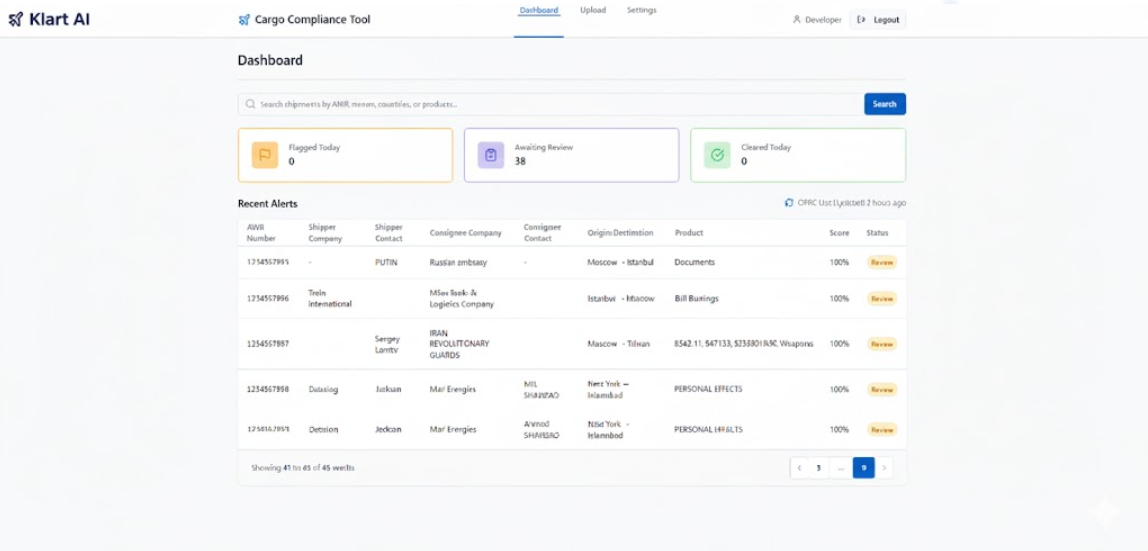
- Coincidencia de sanciones globales: Verifica los nombres de individuos, empresas, y entidades involucradas en el envío contra reportes de sanciones internacionales importantes, incluyendo listas OFAC, UE, y ONU. El sistema es vigilante, como se demuestra por la notificación del panel: "Lista OFAC actualizada hace 2 horas", asegurando que el cumplimiento se base en la información absolutamente más reciente.
- Verificación contextual profunda: Va más allá de la coincidencia de nombres simple al verificar el nombre, el país, la ciudad, el tipo de carga, y el producto en sí contra datos de sanciones mundiales. Los envíos se señalan instantáneamente si involucran partes sensibles (por ejemplo, un nombre de individuo sancionado, contacto para un envío de "Documentos") o usuarios finales restringidos (como la "Guardia Revolucionaria Iraní" recibiendo artículos sancionados o de riesgo).
- Evaluación inteligente y puntuación: Como se ve en el panel, cada posible coincidencia recibe una "Puntuación" (por ejemplo, 100%) indicando el nivel de confianza de una coincidencia, y un "Estado" de "Revisión" se asigna instantáneamente a números de carta de porte aéreo (AWB) de alto riesgo.
- Acción automática: El agente está diseñado para bloquear o autorizar automáticamente el envío basándose en sus hallazgos. Sin embargo, para impactos críticos, como envíos a "embajada rusa", el sistema los señala bajo "Pendiente de revisión" (38 total en el panel de ejemplo), permitiendo que analistas humanos enfoquen sus esfuerzos en las transacciones de mayor riesgo.
- Análisis profundo habilitado por web: El agente puede buscar en la web y aprovechar herramientas adicionales para un análisis profundo en entidades señaladas, asegurando que toma la decisión más informada y correcta para bloquear o autorizar el envío.
El poder de la automatización y la precisión
El resultado de este flujo de trabajo de IA sofisticado es un cambio monumental en eficiencia y gestión de riesgo. El nivel de automatización logrado significa que aproximadamente 99% de todas las verificaciones de cumplimiento se vuelven automáticas, dejando solo los casos más matizados y complejos para analistas humanos. El panel separa claramente el trabajo: 0 señalados hoy automáticamente, 38 pendientes de revisión, y 0 autorizados hoy hasta ahora, ilustrando un sistema enfocado puramente en excepciones de alto riesgo.
Para empresas de carga aérea y envío, esto se traduce en tres ventajas competitivas clave:
- Ahorro de tiempo precioso: Las verificaciones automáticas e instantáneas eliminan la necesidad de horas de verificación cruzada manual, acelerando dramáticamente el procesamiento de carga y reduciendo cuellos de botella de logística.
- Ahorro de costos: Al optimizar el flujo de trabajo de cumplimiento, las empresas reducen los costos operacionales generales y reasignan expertos en cumplimiento humanos para enfocarse en el 1% de casos de alto riesgo que requieren intervención.
- Ahorro de la empresa de multas: Al asegurar cumplimiento continuo y preciso con sanciones mundiales, Klart Compliance actúa efectivamente como un escudo automatizado, previniendo las multas financieras masivas y daño reputacional asociados con violaciones.
Conclusión
La herramienta de cumplimiento de carga de Klart AI proporciona a empresas de carga aérea y envío tres ventajas competitivas principales automatizando casi todas las verificaciones de sanciones. Primero, asegura velocidad operativa rápida eliminando las horas gastadas en verificación cruzada manual, permitiendo verificaciones automáticas instantáneas que aceleran el procesamiento de carga. Segundo, entrega ahorros de costos reduciendo dramáticamente los costos operacionales generales; los expertos en cumplimiento humanos se reasignan eficientemente para enfocarse solo en el complejo 1% de casos que requieren juicio humano. Tercero y más críticamente, actúa como un escudo automatizado contra multas, proporcionando cumplimiento continuo y preciso con sanciones mundiales (incluyendo aquellas de OFAC, la UE, y la ONU), por lo tanto previniendo multas financieras masivas y protegiendo la reputación de la empresa de violaciones.
En resumen, Klart AI asegura que los negocios puedan operar con confianza, salvaguardando su valioso carga y su capacidad de "volar con cumplimiento."